Real Estate Market Forecast 2026: U.S. Investment & Risk

Anúncios
The 2026 U.S. real estate market is poised for dynamic shifts, demanding informed investment strategies and robust risk assessment from property owners to navigate evolving economic landscapes and capitalize on emerging opportunities effectively.
Anúncios
Understanding the future trajectory of the real estate market is paramount for both current property owners and prospective investors. The U.S. Real Estate Forecast 2026 presents a complex yet opportunity-rich landscape, demanding careful consideration of economic indicators, demographic shifts, and technological advancements to craft resilient investment strategies and mitigate potential risks.
Anúncios
Navigating the Economic Landscape in 2026
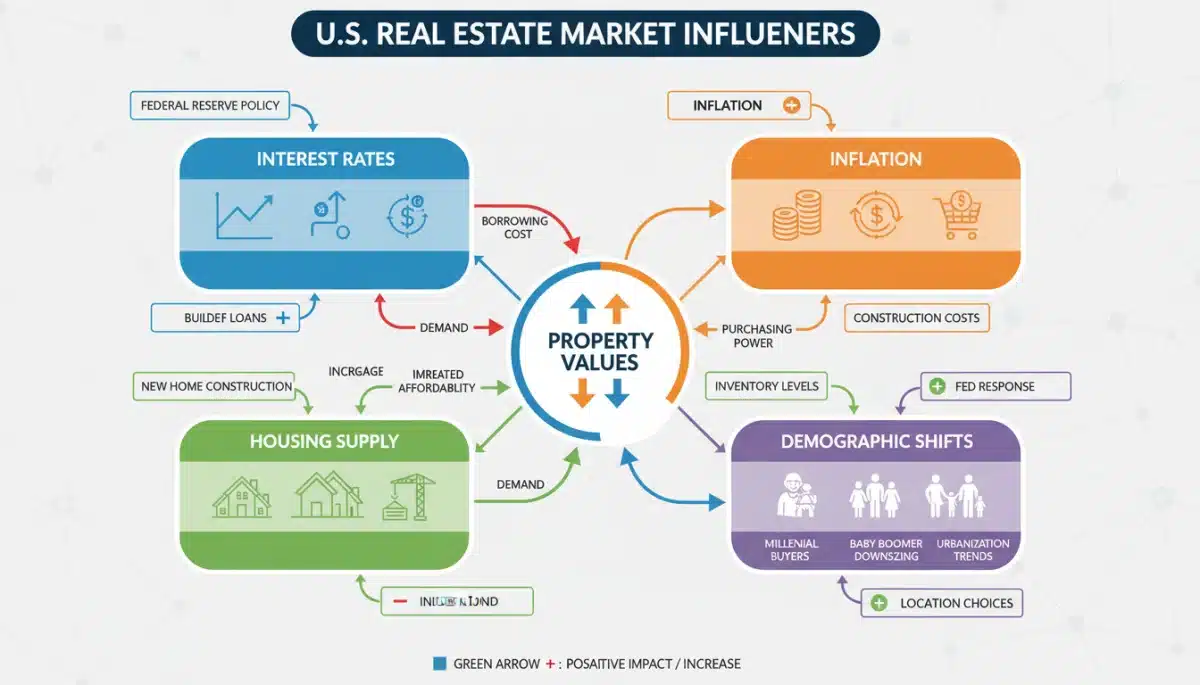
The U.S. economic environment in 2026 is anticipated to be a mosaic of persistent trends and emerging challenges, directly influencing the real estate sector. Inflationary pressures, while potentially moderating, will likely remain a key consideration, impacting construction costs, material prices, and consumer purchasing power. Interest rates, after a period of adjustments, could stabilize or see minor fluctuations, dictating the affordability of mortgages and the attractiveness of real estate as an investment compared to other asset classes.
Labor market dynamics will also play a crucial role. A robust job market generally translates to higher demand for housing, both rental and owned. Conversely, any economic slowdown leading to job losses could dampen this demand. Geopolitical events and global economic shifts, though often unpredictable, can create ripple effects that influence investor confidence and capital flows into the U.S. real estate market. Understanding these macro-economic forces is the first step in formulating a sound investment approach.
Interest Rate Projections and Their Impact
Analysts project that interest rates in 2026 will be largely influenced by the Federal Reserve’s stance on inflation and economic growth. While a return to historically low rates seems unlikely, significant increases are also not widely anticipated. This creates a balanced environment where borrowing costs remain a factor but do not entirely deter investment.
- Mortgage Affordability: Moderate interest rates will keep mortgages accessible, supporting homebuyer demand.
- Developer Costs: Stable rates assist developers in planning and financing new projects without excessive cost volatility.
- Investment Yields: Investors will need to carefully assess property yields against the cost of capital to ensure profitability.
In conclusion, the economic landscape of 2026 will necessitate a nuanced understanding of interconnected factors. Investors and property owners must remain agile, adapting their strategies to economic shifts, particularly concerning inflation, interest rates, and employment figures, to maintain competitive advantage and secure returns.
Key Demographic Shifts and Housing Demand
Demographic trends are powerful, long-term drivers of real estate demand, and 2026 will highlight several significant shifts across the U.S. The ongoing migration patterns, both inter-state and intra-state, continue to reshape local housing markets. Sun Belt states and areas with burgeoning tech or healthcare industries are likely to see sustained population growth, leading to increased demand for housing and associated infrastructure.
The millennial generation, now firmly in their prime home-buying years, will continue to be a dominant force in the housing market, seeking diverse housing options from suburban homes to urban condominiums. Furthermore, the aging baby boomer generation will influence demand for senior living facilities and smaller, more accessible homes. Understanding these generational preferences and migration patterns is vital for identifying areas of future growth and investment potential.
Generational Preferences and Market Segments
Each generation brings unique housing preferences that mold market demand. Millennials prioritize walkability, access to amenities, and often seek properties that align with sustainable living. Generation Z, entering the housing market, may show similar preferences but with an even stronger emphasis on digital connectivity and flexible living spaces.
- Millennial Homeownership: Continued strong demand for first-time and move-up homes, particularly in affordable suburban areas.
- Gen Z Entry: Emerging demand for rental properties and smaller, tech-integrated living units.
- Boomer Downsizing: Increased need for accessible, low-maintenance housing and specialized senior communities.
Ultimately, demographic shifts in 2026 will underscore the importance of targeted development and investment. Recognizing where people want to live, work, and retire will be critical for successful real estate ventures, ensuring that supply meets evolving demand across various market segments.
Investment Strategies for U.S. Property Owners
For U.S. property owners, 2026 presents a compelling environment for strategic investment, but one that demands careful planning and diversification. Diversifying portfolios across different asset classes and geographic locations can mitigate risks associated with localized downturns. Residential real estate, particularly multi-family units and single-family rentals in growth corridors, continues to offer stable income potential and appreciation.
Commercial real estate, while facing ongoing transformations, will see opportunities in sectors like industrial logistics (driven by e-commerce), data centers, and specialized medical office buildings. Traditional office spaces may require repositioning or conversion to meet evolving work patterns. Investors should also consider emerging markets within the U.S. that exhibit strong economic fundamentals, population growth, and infrastructure development.
Value-add strategies, such as renovating existing properties to increase rental income or sale value, will remain relevant. Additionally, exploring innovative financing options and leveraging technology for property management and market analysis can provide a competitive edge. Staying informed about local zoning changes and urban development plans is also crucial for identifying future growth areas.
Diversification and Emerging Opportunities
A well-diversified real estate portfolio is a cornerstone of risk management. This involves not only spreading investments across different property types but also considering various geographic regions within the U.S. Some regions might offer higher growth potential, while others provide more stable, albeit lower, returns.
- Residential Sector: Focus on affordable housing, multi-family units, and build-to-rent communities in suburban and exurban areas.
- Industrial & Logistics: Continued strong demand due to e-commerce expansion and supply chain optimization.
- Specialized Commercial: Healthcare facilities, data centers, and life science labs offer robust growth prospects.
In summary, successful investment strategies in 2026 will hinge on diversification, a keen eye for emerging market opportunities, and the ability to adapt to changing economic and social dynamics. Property owners must proactively seek out undervalued assets and apply value-add approaches to maximize returns.
Assessing Risks in the 2026 Real Estate Market
While opportunities abound, the 2026 U.S. real estate market is not without its risks. A thorough risk assessment is indispensable for protecting investments and ensuring long-term profitability. Economic downturns, whether localized or national, could impact property values and rental income. Inflation, if it escalates unexpectedly, could erode purchasing power and increase operational costs for property owners.
Regulatory changes, such as new zoning laws, environmental regulations, or rent control measures, can significantly affect property rights and investment returns. Climate change risks, including increased frequency of natural disasters, pose physical threats to properties and can lead to higher insurance premiums. Furthermore, technological disruptions, like the rise of proptech, could alter traditional real estate business models, requiring adaptation from market participants.
Mitigating Financial and Market Volatility
Financial risks, such as interest rate hikes or credit market tightening, can impact an investor’s ability to finance new acquisitions or refinance existing loans. Market volatility, influenced by economic cycles and investor sentiment, can lead to fluctuations in property values.
- Stress Testing Portfolios: Evaluate how investments would perform under various adverse economic scenarios.
- Hedging Strategies: Consider fixed-rate mortgages or interest rate swaps to mitigate interest rate risk.
- Diversified Funding: Avoid over-reliance on a single source of financing.
Effective risk assessment in 2026 requires a proactive and multi-faceted approach. Property owners must not only identify potential threats but also develop robust mitigation strategies, encompassing financial planning, regulatory compliance, and environmental considerations, to safeguard their investments.
Technological Innovations Shaping Real Estate
Technology continues to be a transformative force in the real estate sector, and 2026 will see further integration of innovative solutions across all facets of the industry. Artificial intelligence (AI) and machine learning (ML) are enhancing predictive analytics, allowing investors to make more informed decisions about market trends, property valuations, and tenant behavior. Virtual and augmented reality (VR/AR) are revolutionizing property showings and design, offering immersive experiences for buyers and tenants.
Blockchain technology holds promise for streamlining transactions, improving transparency, and reducing fraud in real estate dealings. Smart home technologies and building automation systems are becoming standard, increasing property appeal and operational efficiency. Property owners who embrace these technological advancements can gain a significant competitive advantage, improving tenant satisfaction, reducing costs, and optimizing asset performance.
Proptech and its Investment Implications
The rise of Proptech, or property technology, is not just about making processes more efficient; it’s creating entirely new investment opportunities and business models. From smart building management systems to online real estate marketplaces, Proptech is redefining how properties are bought, sold, and managed.
- Enhanced Analytics: AI-driven platforms provide deeper market insights and risk analysis.
- Automated Management: Smart building systems reduce operational costs and improve tenant experience.
- Fractional Ownership: Blockchain enables new models for real estate investment through tokenization.
In conclusion, technological innovations will be a cornerstone of success in the 2026 real estate market. Property owners and investors must stay abreast of these developments, integrating relevant technologies into their operations and investment strategies to enhance efficiency, attract tenants, and unlock new value.
Regional Market Spotlights: Growth and Challenges
The U.S. real estate market is not monolithic; it’s a collection of diverse regional markets, each with its unique characteristics, growth drivers, and challenges. In 2026, certain regions are projected to outperform others due to a confluence of economic factors, demographic shifts, and policy decisions. For instance, areas in the Sun Belt, particularly those with strong job growth in technology, healthcare, and manufacturing, are likely to continue experiencing robust housing demand and property value appreciation.
Conversely, some markets might face headwinds from out-migration, economic stagnation, or oversupply. Coastal cities, while remaining desirable, could grapple with affordability issues and climate change risks. Understanding these regional nuances is critical for investors looking to allocate capital effectively and for property owners to assess the specific outlook for their assets.
Emerging Hotspots and Potential Headwinds
Identifying emerging hotspots involves looking beyond current trends to areas with future growth potential. This includes cities investing in new infrastructure, attracting major corporations, or experiencing a significant influx of young professionals. However, even in promising regions, potential headwinds such as rising property taxes, increasing regulatory burdens, or labor shortages could impact profitability.
- Sun Belt Expansion: Cities like Austin, Phoenix, and Raleigh continue to attract talent and investment.
- Midwest Renaissance: Selected Midwestern cities are seeing revitalization fueled by tech and manufacturing job growth.
- Coastal Resilience: Major coastal cities will likely maintain value but face challenges in affordability and climate adaptation.
Ultimately, a successful approach to the 2026 real estate market requires a detailed regional analysis. Investors must conduct due diligence on local economic indicators, population trends, and development pipelines to pinpoint the most promising opportunities and understand specific market challenges.
| Key Aspect | 2026 Outlook Summary |
|---|---|
| Economic Environment | Stable interest rates, moderating inflation, and strong labor market support sustained demand. |
| Investment Strategies | Diversification across residential, industrial, and specialized commercial assets; value-add opportunities. |
| Risk Assessment | Mitigate inflation, regulatory changes, and climate risks through proactive planning. |
| Technological Impact | AI, VR/AR, and blockchain revolutionize market analysis, property management, and transaction efficiency. |
Frequently Asked Questions About 2026 Real Estate
Key economic factors include moderating inflation, stable interest rates, and a robust labor market. These elements collectively contribute to consumer confidence and borrowing capacity, directly impacting housing demand and investment viability across various property types.
Regions in the Sun Belt, particularly those with thriving technology, healthcare, and manufacturing sectors, are anticipated to experience strong growth. Cities investing in infrastructure and attracting corporate relocations will also likely be hotspots for appreciation and demand.
Risk mitigation strategies include diversifying portfolios across asset classes and geographies, stress-testing investments against economic downturns, understanding regulatory changes, and preparing for climate-related challenges through adequate insurance and property resilience measures.
Technology, especially AI for analytics, VR/AR for property tours, and blockchain for transactions, will be crucial. Embracing proptech solutions can enhance efficiency, improve tenant experiences, and provide competitive advantages in market analysis and property management.
Both sectors offer opportunities, depending on specific market conditions and investor goals. Residential, particularly multi-family and single-family rentals, offers stability. Commercial, like industrial and specialized healthcare facilities, provides growth. Diversification across both is often recommended.
Conclusion
The U.S. Real Estate Forecast 2026 outlines a dynamic yet promising future for property owners and investors. Success in this evolving market hinges on a strategic blend of informed economic analysis, proactive risk assessment, and an agile approach to investment strategies. By understanding demographic shifts, embracing technological innovations, and paying close attention to regional market nuances, stakeholders can position themselves to capitalize on opportunities and navigate potential challenges effectively. The key lies in continuous learning, adaptation, and a commitment to data-driven decision-making to build resilient and profitable real estate portfolios for the years ahead.