Student Loan Forgiveness 2026: Updates & Eligibility
Anúncios
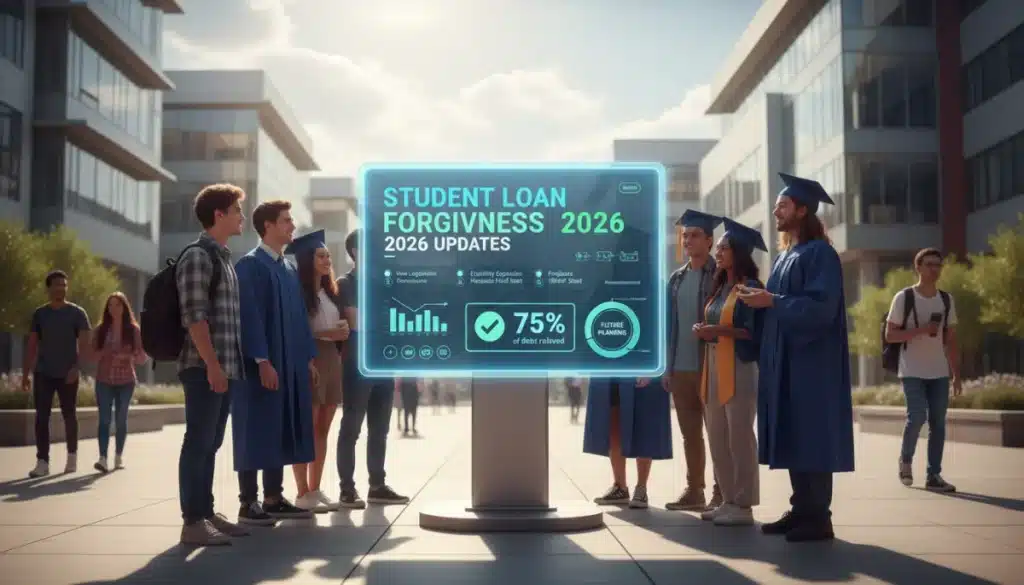
Understanding the evolving landscape of student loan forgiveness 2026 is crucial for borrowers, as new updates and refined eligibility criteria significantly impact opportunities for debt relief and financial planning in the United States.
Navigating the complex world of student loan debt can be daunting, but for many, the promise of student loan forgiveness 2026 offers a beacon of hope. As policies continue to evolve, staying informed about the latest updates and understanding the specific eligibility criteria is paramount for anyone seeking relief from their educational burdens. This comprehensive guide will break down what you need to know, offering practical solutions and insights into recent changes that could significantly impact your financial future.
Anúncios
understanding the current landscape of student loan forgiveness
The landscape of student loan forgiveness is constantly shifting, with new legislative efforts and administrative adjustments occurring regularly. For 2026, borrowers need to be aware of the federal government’s ongoing commitment to addressing student debt, alongside potential changes in existing programs. These changes can often lead to confusion, but understanding the core principles behind these initiatives is the first step toward successful application.
Anúncios
Several key programs remain central to the federal student loan forgiveness effort. These include programs aimed at public servants, those in specific professions, and individuals facing financial hardship. The government’s approach often balances broad relief with targeted assistance, ensuring that various segments of the borrowing population can find pathways to forgiveness.
federal forgiveness programs: an overview
The U.S. Department of Education manages several prominent forgiveness programs. These programs are designed to assist borrowers who meet specific employment, income, or hardship criteria. Knowing which program aligns with your situation is crucial.
- Public Service Loan Forgiveness (PSLF): Designed for individuals working full-time for qualifying non-profit organizations or government agencies.
- Teacher Loan Forgiveness: Aims to encourage individuals to enter and remain in the teaching profession in low-income schools.
- Income-Driven Repayment (IDR) Plan Forgiveness: Offers forgiveness of remaining loan balances after 20 or 25 years of payments under an IDR plan.
- Total and Permanent Disability (TPD) Discharge: Provides relief for borrowers who can no longer work due to a total and permanent disability.
Each of these programs has distinct requirements, and eligibility can be complex. Borrowers should carefully review the criteria for each to determine which options are available to them. The current administration has also been exploring additional avenues for broad-based relief, signaling a continued focus on alleviating student debt burdens.
In conclusion, the current landscape for student loan forgiveness in 2026 is dynamic and offers multiple avenues for relief. Understanding the foundational federal programs and staying updated on any new initiatives is essential for borrowers to make informed decisions about their financial future.
key updates to eligibility criteria in 2026
As we move into 2026, several critical updates to eligibility criteria for student loan forgiveness programs have been implemented or are under consideration. These changes are often a response to economic shifts, policy debates, and efforts to streamline the application process. Borrowers must pay close attention to these modifications, as they could significantly impact their chances of receiving forgiveness.
One notable area of focus for updates involves the Public Service Loan Forgiveness (PSLF) program. While the core tenets of PSLF remain intact, there have been discussions and some adjustments regarding qualifying employment and payment counts. Borrowers who previously believed they were ineligible might find new pathways to meeting the requirements.
revisions in income-driven repayment plans
Income-Driven Repayment (IDR) plans are a cornerstone of federal student loan management, and their forgiveness components are undergoing important revisions. The goal is often to simplify the plans, reduce monthly payments for many borrowers, and accelerate the timeline for forgiveness. These changes are particularly impactful for those with lower incomes or higher debt-to-income ratios.
- Lowered Discretionary Income Calculation: Some updates aim to reduce the percentage of discretionary income used to calculate monthly payments, making payments more affordable.
- Shorter Forgiveness Timelines: For certain borrowers, especially those with smaller original loan balances, the period required for forgiveness under IDR plans might be shortened.
- Addressing Forbearance and Deferment: New policies are being considered to count certain periods of forbearance and deferment towards loan forgiveness, rectifying past inconsistencies.
These revisions are designed to make IDR plans more effective tools for managing student debt and ultimately achieving forgiveness. Borrowers currently on an IDR plan or considering enrolling should review these updates carefully to understand how they might benefit.
The evolving eligibility criteria in 2026 underscore the importance of continuous monitoring of official announcements from the Department of Education. These updates are designed to refine the programs and potentially expand access to forgiveness for a broader range of borrowers.
public service loan forgiveness (PSLF): what’s new for 2026?
The Public Service Loan Forgiveness (PSLF) program continues to be a vital avenue for debt relief for those dedicated to public service. In 2026, while the fundamental principles of PSLF remain consistent, there are important clarifications and procedural enhancements that borrowers need to be aware of. These updates aim to improve the program’s efficiency and address common challenges faced by applicants.
A significant focus has been on simplifying the process of certifying employment and tracking qualifying payments. The Department of Education has recognized the historical complexities of PSLF and is working to make it more accessible and transparent for eligible borrowers. This includes better communication and clearer guidelines.
streamlining employment certification
One of the persistent hurdles for PSLF applicants has been the employment certification process. For 2026, efforts are being made to streamline this, potentially through more integrated systems or clearer guidance for employers. This aims to reduce errors and delays that have historically plagued the program.
- Automated Data Sharing: Exploring options for direct data sharing with federal employers to verify employment more efficiently.
- Standardized Forms: Updates to the PSLF Employment Certification Form to make it more intuitive and less prone to common mistakes.
- Employer Education Initiatives: Providing better resources and training for qualifying employers on how to properly certify employment for their staff.
These initiatives are crucial for ensuring that eligible public servants can more easily demonstrate their qualifying employment, a cornerstone of the PSLF program. The goal is to minimize administrative burdens and accelerate the path to forgiveness for dedicated individuals.
Furthermore, discussions around potential expansions of what constitutes ‘qualifying employment’ are ongoing, though specific legislative changes would be required for broader alterations. Borrowers should continue to certify their employment regularly to ensure all payments are counted correctly.
In essence, 2026 brings a renewed commitment to making PSLF work more effectively for those who serve the public. These procedural improvements are designed to foster greater trust and accessibility within the program.
teacher loan forgiveness and other professional programs
Beyond PSLF, several other professional-specific loan forgiveness programs continue to play a critical role in addressing student debt, particularly for those in high-need fields. Teacher Loan Forgiveness (TLF) is one such program, and in 2026, its structure remains a key incentive for educators. Understanding its specific requirements and how it interacts with other programs is essential for teachers.
Other professional programs target individuals in healthcare, law, and various government roles, often at the state or local level, in addition to federal initiatives. These programs are designed to address workforce shortages and encourage service in underserved communities. While their scope may be narrower than PSLF, they offer substantial relief for eligible professionals.
eligibility for teacher loan forgiveness
The Teacher Loan Forgiveness program offers up to $17,500 in forgiveness for highly qualified teachers who serve for five consecutive complete academic years in low-income schools or educational service agencies. For 2026, the criteria for ‘highly qualified’ and ‘low-income school’ remain central to eligibility.
- Highly Qualified Teacher Status: Must meet state certification and licensing requirements, hold a bachelor’s degree, and demonstrate subject matter competence.
- Low-Income School Directory: Employment must be in a school listed in the annual Teacher Cancellation Low Income (TCLI) Directory.
- Full-Time Service: Five consecutive full-time academic years of teaching are required.
It’s important to note that borrowers cannot receive both PSLF and TLF for the same period of service. Teachers must carefully evaluate which program offers the greater benefit given their specific circumstances and loan types. The maximum forgiveness amount under TLF is significantly less than what is potentially available through PSLF, but it requires a shorter service period.
Beyond teaching, programs exist for nurses, doctors, and other medical professionals serving in underserved areas, often through the National Health Service Corps (NHSC) or state-specific initiatives. Legal professionals working in public interest roles may also find state or federal programs offering assistance.
In summary, 2026 continues to offer targeted forgiveness options for professionals in critical fields. These programs serve as incentives for individuals to pursue and remain in careers that directly benefit communities, while also providing much-needed student debt relief.
strategies for navigating the application process
Successfully applying for student loan forgiveness requires careful attention to detail and a thorough understanding of the application process. In 2026, while efforts are underway to simplify these procedures, borrowers still need to be proactive and organized. Missteps in the application can lead to significant delays or even denial of forgiveness.
The first and most crucial step is to identify the correct program for which you are eligible. Once that is determined, gathering all necessary documentation and adhering strictly to deadlines becomes paramount. It’s not just about meeting the criteria, but also proving that you meet them through impeccable record-keeping.
essential documentation and best practices
Regardless of the forgiveness program, certain documents are almost universally required. Having these readily accessible and accurately completed will significantly smooth the application process. Procrastination or missing information are common pitfalls.
- Loan Records: Keep detailed records of all your federal student loans, including disbursement dates, servicers, and payment history.
- Employment Verification: Obtain official documentation from all qualifying employers, clearly stating your employment dates and full-time status.
- Income Documentation: Be prepared to submit tax returns or other income verification if applying for income-driven repayment forgiveness.
- Disability Documentation: For TPD discharge, ensure you have comprehensive medical records from an approved physician.
Beyond documentation, establishing best practices for managing your loans from the outset can prevent future headaches. This includes making on-time payments, understanding your loan types, and regularly communicating with your loan servicer. Don’t wait until you’re ready to apply for forgiveness to start organizing your financial records.
Many borrowers benefit from utilizing online tools and resources provided by the Department of Education, which often include loan trackers and application guides. These resources are designed to help borrowers navigate the complexities of federal student aid programs.
Successfully navigating the application process for student loan forgiveness in 2026 hinges on preparation, accuracy, and diligence. By following best practices and staying informed, borrowers can significantly increase their chances of achieving debt relief.
potential future changes and advocacy for borrowers
The landscape of student loan forgiveness is not static; it is continually shaped by policy debates, economic conditions, and advocacy efforts. Looking beyond the immediate 2026 updates, it’s important for borrowers to be aware of potential future changes and how they can contribute to advocacy for more effective and accessible debt relief programs. The conversation around student debt is ongoing, and new legislative proposals frequently emerge.
Advocacy groups and consumer protection agencies play a crucial role in pushing for borrower-friendly policies. They highlight systemic issues within the student loan system and propose solutions that could lead to broader forgiveness or more equitable repayment terms. Staying informed about these discussions can give borrowers a sense of what might be on the horizon.
the role of legislative action
Significant changes to student loan forgiveness programs often require legislative action from Congress. This means that proposals for new programs, expansions of existing ones, or fundamental reforms are subject to political processes and bipartisan negotiation. Borrowers should monitor news from Capitol Hill regarding education and finance.
- Proposed Bills: Keep an eye on new bills introduced in Congress that aim to address student loan debt.
- Executive Actions: Understand that while executive actions can provide some relief, comprehensive and lasting changes often need legislative support.
- Public Pressure: The collective voice of borrowers and advocates can influence lawmakers to prioritize student debt relief.
Engagement with elected officials, sharing personal stories, and supporting organizations that champion borrower rights are all ways individuals can contribute to advocacy efforts. Even small actions can collectively create pressure for meaningful policy changes.
Furthermore, discussions about the fundamental structure of higher education financing, including tuition costs and federal aid, are intertwined with the debate on student loan forgiveness. Addressing the root causes of student debt is often seen as a complementary approach to providing relief for existing borrowers.
In conclusion, while 2026 brings specific updates, the future of student loan forgiveness is subject to ongoing debate and potential legislative shifts. Borrowers have a role to play in shaping these future policies through informed advocacy.
| Key Program | Brief Description |
|---|---|
| Public Service Loan Forgiveness (PSLF) | Forgiveness after 120 qualifying payments for full-time public service employees. |
| Income-Driven Repayment (IDR) | Monthly payments based on income, with remaining balance forgiven after 20-25 years. |
| Teacher Loan Forgiveness | Up to $17,500 for highly qualified teachers in low-income schools. |
| Total and Permanent Disability (TPD) Discharge | Loan discharge for borrowers unable to work due to a total and permanent disability. |
frequently asked questions about student loan forgiveness 2026
Major changes for 2026 include streamlined processes for PSLF employment certification and revisions to Income-Driven Repayment (IDR) plans, aiming to lower monthly payments and potentially shorten forgiveness timelines for some borrowers. These updates are intended to simplify access and expand eligibility.
To qualify for PSLF in 2026, you must be employed full-time by a U.S. federal, state, local, or tribal government organization or a qualifying non-profit. You must also make 120 qualifying monthly payments under a qualifying repayment plan.
While you may meet the criteria for both, you cannot receive both PSLF and Teacher Loan Forgiveness for the same period of service. It is crucial to evaluate which program offers the greater financial benefit based on your specific loan amounts and service commitment.
IDR plans adjust your monthly payment based on your income and family size. After 20 or 25 years of qualifying payments, any remaining loan balance is forgiven. Recent 2026 updates aim to make these plans more affordable and potentially shorten the forgiveness period for some.
The most reliable source for information on student loan forgiveness updates is the official website of the U.S. Department of Education and Federal Student Aid (StudentAid.gov). Regularly check their announcements and program guidelines for the latest and most accurate details.
conclusion
The journey toward understanding and utilizing student loan forgiveness 2026 programs can be intricate, yet it offers significant relief for many borrowers. With ongoing updates to eligibility criteria, particularly within PSLF and IDR plans, staying informed is not just beneficial but essential. By diligently tracking changes, maintaining meticulous records, and proactively engaging with official resources, borrowers can effectively navigate the application process and secure the financial freedom they deserve. The commitment to addressing student debt remains strong, making 2026 a critical year for borrowers to explore and pursue their forgiveness options.