2026 Social Security COLA: What US Beneficiaries Can Expect

Anúncios
The 2026 Social Security Cost-of-Living Adjustment (COLA) is crucial for US beneficiaries, directly impacting their purchasing power by adjusting benefits to combat inflation, with its calculation based on consumer price index data.
As we advance towards 2026, understanding the 2026 Social Security Cost-of-Living Adjustment (COLA): What U.S. Beneficiaries Can Expect becomes increasingly vital for millions of Americans who rely on these benefits. This adjustment is not merely a number; it represents a critical lifeline, ensuring that the purchasing power of Social Security benefits keeps pace with the rising costs of living.
Anúncios
Understanding the COLA Mechanism and Its Importance
The Cost-of-Living Adjustment, or COLA, is an essential provision within the Social Security system designed to protect beneficiaries from the erosion of their purchasing power due to inflation. Without COLA, the fixed income of retirees, survivors, and disabled individuals would steadily lose value over time, making it harder to afford daily necessities. This annual adjustment is a cornerstone of financial stability for many.
Anúncios
The mechanism for calculating COLA is tied directly to inflation, specifically using a measure known as the Consumer Price Index for Urban Wage Earners and Clerical Workers (CPI-W). This index tracks the average change over time in the prices paid by urban consumers for a market basket of consumer goods and services. The Social Security Administration (SSA) compares the CPI-W from the third quarter of the current year to the third quarter of the previous year to determine the adjustment. A rise in the CPI-W translates into an increase in Social Security benefits.
The Historical Context of COLA
COLA has been a regular feature of Social Security since 1975, though its origins can be traced back to earlier ad hoc adjustments. The formalization of the COLA process was a direct response to periods of high inflation in the early 1970s, which severely impacted the financial well-being of beneficiaries. Its introduction ensured a more systematic and predictable way to safeguard benefit values.
- 1975: First automatic COLA implemented.
- CPI-W Basis: Established as the primary inflation measure for COLA calculations.
- Protection Against Inflation: Designed to maintain beneficiaries’ purchasing power.
- Annual Review: Ensures regular adjustments based on economic realities.
The importance of COLA cannot be overstated. For many beneficiaries, Social Security represents a significant, if not primary, source of income. A robust COLA ensures that essential expenses like food, housing, and healthcare remain within reach, even as prices continue to climb. It provides a crucial sense of security and predictability in retirement planning.
In conclusion, the COLA mechanism is a vital component of the Social Security system, acting as a bulwark against inflation. Its design ensures that the benefits earned over a lifetime of work continue to provide meaningful support, adapting to the economic landscape and protecting the financial stability of millions of Americans.
Key Economic Indicators Influencing the 2026 COLA
Forecasting the 2026 Social Security COLA requires a close examination of several key economic indicators, particularly those related to inflation. The primary driver, as always, will be the Consumer Price Index for Urban Wage Earners and Clerical Workers (CPI-W). However, other broader economic trends and projections for the coming years also play a significant role in shaping expectations.
Inflationary pressures are multifaceted, stemming from various sectors of the economy. Energy prices, housing costs, and food prices are typically major contributors to the CPI-W. Geopolitical events, supply chain disruptions, and shifts in consumer demand can all exert upward or downward pressure on these prices. Monitoring these elements is crucial for anticipating the magnitude of the next COLA.
The Role of the CPI-W and Its Limitations
The CPI-W is specifically designed to reflect the spending patterns of urban wage earners and clerical workers, making it a relevant but not universally representative measure. Critics often point out that the CPI-W may not fully capture the unique spending habits and cost burdens faced by seniors, particularly regarding healthcare expenses, which tend to rise faster than general inflation.
While alternative indices like the Consumer Price Index for the Elderly (CPI-E) have been proposed, the CPI-W remains the statutory basis for COLA calculations. This distinction is important because a COLA calculated using CPI-E would likely result in higher adjustments more frequently, better reflecting the actual cost of living for many beneficiaries. However, any shift to CPI-E would require legislative action, which has not yet materialized.
- CPI-W Focus: Urban wage earners and clerical workers.
- Healthcare Costs: Often a higher proportion of senior spending.
- CPI-E Proposal: A potential alternative for more accurate senior inflation.
- Legislative Hurdle: Requires Congressional approval for change.
Beyond the CPI-W, broader economic forecasts from organizations like the Congressional Budget Office (CBO) and the Federal Reserve provide valuable context. These forecasts include projections for GDP growth, unemployment rates, and overall inflation, all of which indirectly influence the environment in which the CPI-W develops. A strong economy with low unemployment may lead to wage growth, which can contribute to inflationary pressures, potentially boosting COLA.
In summary, while the CPI-W is the direct determinant, a holistic view of economic indicators—from energy prices to housing markets and broader macroeconomic trends—is essential for understanding and projecting the 2026 COLA. These factors collectively paint a picture of the inflationary landscape that will ultimately dictate the adjustment amount.
Historical COLA Trends and Future Projections
Examining historical COLA trends offers valuable insights into what beneficiaries might expect for 2026. Over the past few decades, COLA percentages have fluctuated significantly, reflecting periods of both high and low inflation. Understanding these patterns, combined with current economic projections, allows for more informed speculation about future adjustments.
In recent history, we’ve seen a range of COLA figures. There have been years with no COLA at all, particularly during periods of very low inflation or even deflation, as well as years with substantial increases, such as during the high inflation of the early 1980s or more recently in the early 2020s. These variations highlight the direct correlation between consumer prices and benefit adjustments.
Recent COLA Highlights
The past few years have presented a dynamic economic landscape, resulting in notable COLA adjustments. For instance, the COLA for 2022 and 2023 saw significant increases, reflecting a surge in inflation driven by supply chain issues, increased consumer demand, and geopolitical events. These larger adjustments were crucial for beneficiaries facing rapidly rising costs for everyday goods and services.
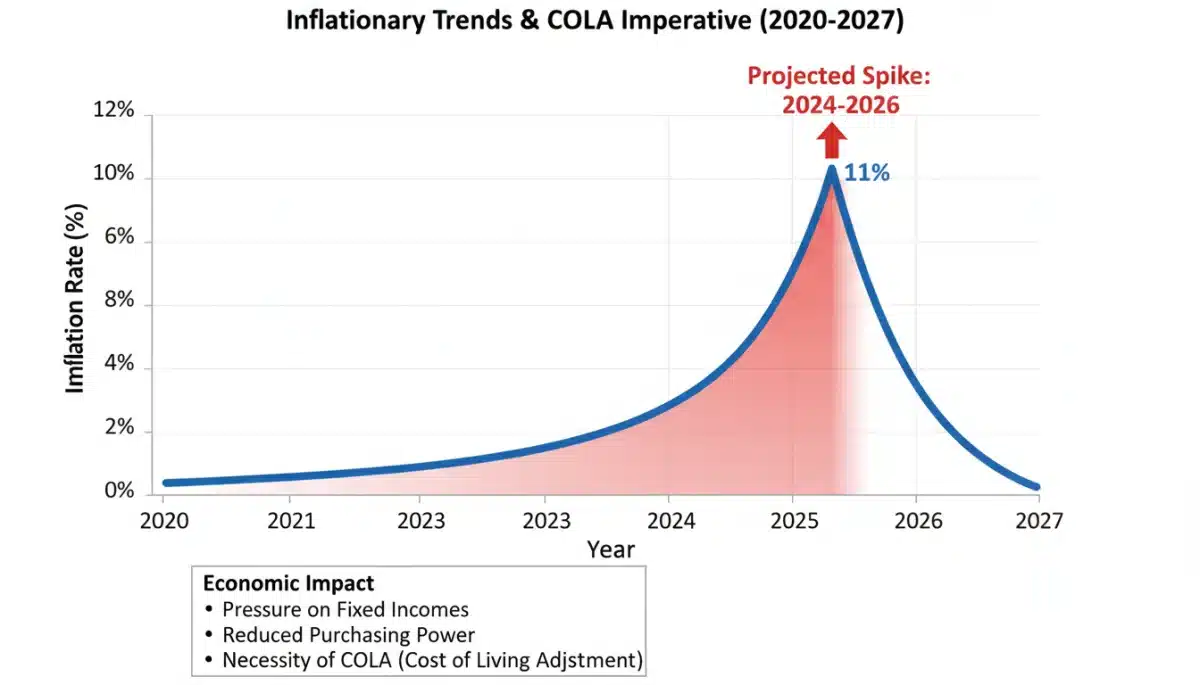
Conversely, periods of economic stability or recession have led to much smaller, or even zero, COLA increases. This demonstrates the system’s responsiveness to the economic climate, ensuring that adjustments are made only when inflation genuinely erodes purchasing power.
- High Inflation Years: Result in larger COLA increases.
- Low Inflation Years: Lead to smaller or no COLA.
- Economic Impact: COLA directly reflects economic conditions.
- Beneficiary Protection: Ensures benefits keep pace with costs.
Looking ahead to 2026, various economic models and expert opinions suggest a potential moderation in inflation compared to the peaks of recent years, but still above historical averages. Factors such as ongoing global economic shifts, labor market dynamics, and fiscal policies will all play a part. While precise predictions are impossible far in advance, current projections lean towards a moderate COLA, rather than an exceptionally high or zero adjustment.
In conclusion, historical COLA trends underscore the dynamic nature of benefit adjustments. For 2026, while the exact figure remains elusive, the interplay of past patterns and current economic forecasts points towards a COLA that will continue to be a vital component in preserving the financial stability of Social Security beneficiaries.
Impact on U.S. Beneficiaries: Financial Implications
The 2026 Social Security COLA will have significant financial implications for millions of U.S. beneficiaries, directly influencing their monthly income and, consequently, their purchasing power. Even a small percentage change in COLA can translate into hundreds of dollars annually for individuals and families relying on these benefits, affecting their ability to cover essential expenses.
For retirees, survivors, and individuals with disabilities, Social Security often constitutes a substantial portion of their income. A meaningful COLA helps to offset the rising costs of goods and services, preventing a decline in their standard of living. This is particularly crucial for those on fixed incomes who have limited opportunities to increase their earnings through employment.
Navigating Rising Costs with COLA
Beneficiaries frequently face escalating costs in critical areas such as healthcare, housing, and groceries. While COLA aims to address these increases, the effectiveness can vary. Healthcare costs, for instance, often outpace general inflation, meaning that even with a COLA, some beneficiaries may still feel a squeeze on their budgets when it comes to medical expenses and prescription drugs.
Understanding how the COLA translates into actual dollars is key for personal financial planning. Beneficiaries should review their projected COLA increase and compare it against their anticipated expenses for 2026. This allows for proactive adjustments to budgets and spending habits, ensuring financial resilience in the face of ongoing economic changes.
- Increased Monthly Income: Directly impacts spending power.
- Offsetting Inflation: Helps maintain living standards.
- Healthcare Challenges: Costs may still outpace COLA for some.
- Budget Planning: Essential for maximizing COLA benefits.
Beyond direct benefit increases, COLA can also indirectly affect other aspects of beneficiaries’ financial lives. For some, a higher Social Security income might push them into a different tax bracket, potentially increasing their tax liability on benefits. Additionally, for those receiving other means-tested benefits, a COLA increase could, in rare cases, impact their eligibility or the amount of those supplementary benefits.
Ultimately, the 2026 COLA is a critical factor in the financial well-being of U.S. beneficiaries. It serves as a necessary adjustment to help them manage the ever-present challenge of rising costs, although careful personal financial planning remains paramount to fully leverage its protective effects.
Strategies for Beneficiaries: Maximizing Your Social Security
While the 2026 Social Security COLA is an automatic adjustment, beneficiaries can still employ various strategies to maximize the value of their Social Security income and ensure financial stability. Proactive planning and careful management of resources can significantly enhance the impact of any COLA increase, helping to stretch every dollar further.
One fundamental strategy involves understanding one’s own spending patterns and creating a detailed budget. Knowing exactly where money goes allows beneficiaries to identify areas for potential savings, making their Social Security benefits, including any COLA adjustment, more effective in covering essential expenses and even allowing for discretionary spending or savings.
Financial Planning and Budgeting
Beyond basic budgeting, beneficiaries should explore opportunities to reduce fixed costs. This could involve refinancing a mortgage if interest rates are favorable, evaluating insurance policies for more competitive rates, or exploring options for lower-cost healthcare plans, such as Medicare Advantage plans, if suitable. Every dollar saved on recurring expenses effectively increases the purchasing power of Social Security benefits.
Another important aspect is to stay informed about potential changes to Social Security rules or related programs. Policies regarding taxation of benefits, eligibility for other government assistance, or healthcare subsidies can evolve, and being aware of these changes allows beneficiaries to adapt their financial strategies accordingly. Resources from the Social Security Administration, AARP, and financial advisory services can be invaluable.
- Detailed Budgeting: Understand and track all expenses.
- Reduce Fixed Costs: Seek lower rates for housing, insurance, etc.
- Stay Informed: Monitor changes in Social Security and related policies.
- Seek Advice: Consult financial advisors for personalized strategies.
For those still able to work, even part-time employment can significantly supplement Social Security income. It’s important to understand the earnings test rules if you are below full retirement age, as earning too much can temporarily reduce benefits. However, for those at or above full retirement age, there are no limits on earnings. This can provide an additional buffer against inflation, complementing the COLA.
In conclusion, while the 2026 COLA provides an essential inflation hedge, beneficiaries can further enhance their financial security through diligent budgeting, strategic cost reduction, staying informed about policy changes, and exploring supplementary income opportunities. These proactive steps ensure that Social Security benefits continue to provide robust support.
The Political and Legislative Landscape Surrounding COLA
The annual Social Security COLA, while based on an economic formula, is not immune to the broader political and legislative landscape. Discussions around Social Security’s long-term solvency often bring COLA into focus, with various proposals emerging from policymakers regarding its calculation and overall impact. These debates can influence not only future COLA methodologies but also the public’s perception of the program.
One recurring theme in legislative discussions is the potential for changing the index used to calculate COLA. As mentioned earlier, the CPI-W is often criticized for not accurately reflecting the spending patterns of seniors. Proposals to switch to the CPI-E, or other inflation measures, frequently surface. Such a change would require Congressional action and would likely be a topic of intense debate, given its significant financial implications for both beneficiaries and the Social Security trust funds.
Debates on COLA Calculation Methods
Beyond the index itself, there are also discussions about the overall funding and structure of Social Security. Any major legislative reforms aimed at ensuring the program’s long-term sustainability could indirectly or directly impact future COLA adjustments. For instance, proposals to raise the full retirement age, adjust the benefit formula, or increase payroll taxes could alter the economic environment in which COLA is determined.
Political considerations often revolve around balancing the needs of current beneficiaries with the fiscal health of the program for future generations. Lawmakers must weigh the immediate impact of COLA adjustments on seniors’ incomes against the long-term solvency projections of the Social Security trust funds. This delicate balance makes COLA a perennial subject of policy debate.
- Index Change Proposals: CPI-E vs. CPI-W.
- Legislative Reforms: Potential impacts on COLA.
- Fiscal Solvency: A key consideration in COLA debates.
- Political Balancing Act: Present needs vs. future sustainability.
Public opinion and advocacy groups also play a crucial role in shaping the political discourse around COLA. Organizations representing seniors often lobby for robust COLA increases and for the adoption of more senior-friendly inflation measures. Their advocacy helps to keep the issue on the legislative agenda and ensures that the voices of beneficiaries are heard.
In conclusion, while the 2026 COLA will be determined by an established formula, the political and legislative landscape remains an important backdrop. Ongoing debates about the calculation method, broader Social Security reforms, and the influence of advocacy groups all contribute to the dynamic environment surrounding this vital benefit adjustment.
Preparing for the 2026 COLA Announcement and Beyond
As the time for the 2026 Social Security COLA announcement approaches, beneficiaries and those planning for retirement should begin preparing to understand its implications. The official announcement, typically made in October of the preceding year (e.g., October 2025 for the 2026 COLA), provides the definitive percentage increase. However, preparation can start much earlier by staying informed about economic trends.
Staying abreast of inflation forecasts and general economic news throughout 2025 can give beneficiaries a preliminary sense of what to expect. While these are not official figures, they can help in preliminary budgeting and financial adjustments. Reputable financial news outlets, government economic reports, and analyses from financial institutions are good sources of information.
Post-Announcement Actions for Beneficiaries
Once the 2026 COLA is officially announced, beneficiaries should take several concrete steps. The first is to verify the exact increase to their monthly benefit, which will typically be reflected in their December statement or accessible through their online Social Security account. This precise figure is essential for updating personal budgets and financial plans.
It’s also a good time to review other financial aspects that might be indirectly affected. This includes re-evaluating Medicare premiums, particularly Part B, which are often deducted directly from Social Security benefits. While a ‘hold harmless’ provision usually prevents Part B premiums from reducing a beneficiary’s net Social Security payment, a significant COLA can sometimes affect this, especially for new enrollees or those not covered by the provision.
- Monitor Economic News: Stay informed about inflation trends.
- Verify Official Announcement: Check SSA for the exact COLA percentage.
- Update Budget: Adjust personal finances based on new benefit amount.
- Review Medicare Premiums: Understand any changes to Part B deductions.
Beyond the immediate financial adjustments, beneficiaries should consider the long-term implications of COLA trends. Understanding that future COLA amounts will continue to be tied to inflation means that ongoing financial planning should incorporate this variability. Diversifying income sources, if possible, and maintaining an emergency fund can provide additional security against unforeseen economic shifts.
In conclusion, preparing for the 2026 COLA announcement involves both proactive monitoring of economic indicators and diligent post-announcement actions. By staying informed, verifying benefit changes, and adapting financial strategies, U.S. beneficiaries can effectively navigate the adjustments and ensure their Social Security benefits continue to support their financial well-being now and in the future.
| Key Point | Brief Description |
|---|---|
| COLA Purpose | Adjusts Social Security benefits annually to counteract inflation and maintain beneficiaries’ purchasing power. |
| Calculation Basis | Determined by the Consumer Price Index for Urban Wage Earners and Clerical Workers (CPI-W) from Q3 year-over-year. |
| Beneficiary Impact | Directly affects monthly income, helping cover rising costs like healthcare and housing, crucial for financial stability. |
| Preparation | Monitor economic forecasts, verify the official announcement, and adjust personal budgets and financial plans accordingly. |
Frequently Asked Questions About the 2026 COLA
The main purpose of the Social Security Cost-of-Living Adjustment (COLA) is to ensure that the purchasing power of Social Security benefits is not eroded by inflation. It helps beneficiaries maintain their standard of living as the cost of goods and services rises over time.
The 2026 COLA will be calculated by comparing the average Consumer Price Index for Urban Wage Earners and Clerical Workers (CPI-W) from the third quarter of 2025 to the third quarter of 2024. The percentage increase in CPI-W determines the COLA.
The Social Security Administration typically announces the official Cost-of-Living Adjustment for the upcoming year in October. Therefore, the 2026 COLA is expected to be announced in October of 2025.
Yes, the COLA can indirectly affect Medicare Part B premiums. While a ‘hold harmless’ provision generally prevents premiums from reducing net Social Security payments, a significant COLA can sometimes lead to an increase in premiums for certain beneficiaries, especially those not covered by the provision.
Beneficiaries can maximize their benefits by creating a detailed budget, seeking ways to reduce fixed expenses, staying informed about policy changes, and considering part-time work if appropriate and within earnings limits. Consulting a financial advisor for personalized strategies is also beneficial.
Conclusion
The 2026 Social Security Cost-of-Living Adjustment stands as a critical factor in the financial landscape for millions of U.S. beneficiaries. Designed to be a bulwark against the eroding effects of inflation, its calculation, rooted in the CPI-W, directly influences the purchasing power and overall financial stability of retirees, survivors, and individuals with disabilities. While the exact percentage will be revealed in due course, understanding the economic indicators, historical trends, and potential legislative discussions surrounding COLA allows beneficiaries to approach the future with informed preparedness. Proactive financial planning, diligent budgeting, and staying abreast of official announcements are essential steps to ensure that Social Security continues to fulfill its vital role in supporting the well-being of its recipients.