High-Yield Savings Accounts 2026: Best APY 4.5%+ Comparison
Anúncios
Finding the best high-yield savings accounts in 2026 requires comparing options with APYs above 4.5% to optimize your cash growth effectively.
In 2026, navigating the landscape of financial products can feel overwhelming, especially when seeking the best returns on your hard-earned money. Understanding and comparing high-yield savings accounts is more critical than ever, as these accounts offer a robust solution for growing your cash beyond traditional options. We will delve into what makes an account stand out, focusing on those boasting an Annual Percentage Yield (APY) above 4.5%.
Anúncios
Understanding high-yield savings accounts (HYSAs)
High-yield savings accounts are more than just a place to store your money; they are a strategic tool for wealth accumulation. Unlike traditional savings accounts, HYSAs offer significantly higher interest rates, allowing your money to grow at a much faster pace. This difference can translate into substantial gains over time, making them an attractive option for both short-term savings goals and long-term financial planning.
Anúncios
These accounts are typically offered by online banks, which often have lower overhead costs compared to brick-and-mortar institutions. These savings are then passed on to consumers in the form of higher interest rates. Understanding the mechanics of how these accounts operate is the first step toward making an informed decision about where to place your cash.
What defines a high-yield account?
A high-yield account is primarily defined by its Annual Percentage Yield (APY), which represents the real rate of return earned on an investment, taking into account the effect of compounding interest. For 2026, we are specifically looking at accounts that offer an APY exceeding 4.5%, a benchmark that signifies a competitive and beneficial return in the current economic climate.
- Competitive APY: Aim for rates significantly above the national average for standard savings accounts.
- FDIC Insurance: Ensure your funds are protected by the Federal Deposit Insurance Corporation up to $250,000 per depositor, per insured bank, for each account ownership category.
- Minimal Fees: Look for accounts with no monthly maintenance fees or easy ways to waive them.
- Accessibility: While often online, ensure convenient access to your funds when needed.
Choosing the right high-yield savings account involves more than just looking at the APY. It requires a comprehensive understanding of the account’s features, any associated fees, and how easily you can access your money. By focusing on these elements, you can ensure that your chosen account aligns with your financial goals and provides the best possible value.
Key factors to consider beyond APY
While a high APY is undoubtedly the primary draw for these accounts, it is not the only metric that matters. Several other crucial factors can significantly impact the overall value and suitability of a high-yield savings account for your specific needs. Overlooking these details could lead to unexpected costs or limitations, diminishing the benefits of a higher interest rate.
It is essential to adopt a holistic view when evaluating different options, ensuring that the account not only offers a great return but also fits seamlessly into your financial life. This includes understanding the fine print and anticipating any potential hurdles.
Fees and minimum balance requirements
Many high-yield savings accounts come with specific conditions that, if not met, can erode your earnings. Monthly maintenance fees are a common culprit, as are penalties for falling below a certain minimum balance. Some accounts might require a substantial initial deposit to open or to qualify for the advertised APY.
- Monthly Fees: Verify if there are any recurring charges and how to avoid them (e.g., maintaining a minimum balance, setting up direct deposit).
- Minimum Deposit: Check the initial deposit requirement to open the account.
- Minimum Balance: Understand if there’s a minimum balance needed to earn the stated APY or avoid fees.
- Transaction Fees: Be aware of potential fees for excessive withdrawals or transfers.
Carefully reviewing the fee schedule and minimum balance requirements is a critical step in the comparison process. An account with a slightly lower APY but no fees might ultimately offer a better net return than one with a higher APY burdened by various charges. Always do the math to see the true cost of the account.
FDIC insurance and account security
The security of your deposits is paramount, especially when entrusting your money to a financial institution. In the United States, the Federal Deposit Insurance Corporation (FDIC) plays a vital role in protecting consumers’ funds. Understanding how FDIC insurance works and confirming that your chosen high-yield savings account is covered is non-negotiable for peace of mind.
Beyond FDIC insurance, banks employ various security measures to protect your account from fraud and unauthorized access. These measures are equally important in safeguarding your financial information in an increasingly digital world. Always look for institutions that prioritize robust security protocols.
Ensuring your money is safe
All reputable banks offering high-yield savings accounts in the U.S. will be FDIC-insured. This means that, even if the bank were to fail, your deposits are protected up to $250,000 per depositor, per insured bank, for each account ownership category. This protection is a cornerstone of the American banking system, providing a safety net for savers.
- Verify FDIC Membership: Always confirm that the bank is an FDIC member. This information is usually prominently displayed on their website.
- Understand Coverage Limits: Be aware of the $250,000 limit. If you have more than this amount in one bank, consider spreading your funds across multiple FDIC-insured institutions.
- Online Security Features: Look for features like two-factor authentication, encryption, and fraud monitoring to protect your account from cyber threats.
The combination of FDIC insurance and strong digital security measures provides a comprehensive shield for your savings. When comparing accounts, never compromise on these aspects. A high APY is only beneficial if your principal is secure.
Online versus brick-and-mortar banks
The rise of online banking has significantly reshaped the financial landscape, particularly in the realm of high-yield savings accounts. Online banks often boast higher APYs due to their lower operating costs, lacking the extensive physical infrastructure of traditional brick-and-mortar institutions. This fundamental difference leads to distinct advantages and disadvantages for consumers.
Deciding between an online-only bank and one with physical branches involves weighing convenience, accessibility, and the interest rates offered. Your personal banking preferences and needs will heavily influence which type of institution is the better fit for your high-yield savings.
Pros and cons of online banks
Online banks generally offer the most competitive APYs for high-yield savings accounts. Their digital-first model allows them to pass on savings from not maintaining physical branches directly to customers in the form of higher interest rates and often fewer fees. This makes them a strong contender for those prioritizing maximum returns.
- Higher APYs: Typically offer significantly better interest rates than traditional banks.
- Lower Fees: Often have fewer or no monthly maintenance fees.
- Convenience: Manage your account 24/7 from anywhere with an internet connection.
- Limited Physical Access: No branches for in-person transactions or cash deposits.
- Digital Interaction: Customer service primarily through phone, chat, or email.
Traditional banks, while offering the familiarity of physical locations and in-person service, usually cannot compete with the APYs of online-only institutions. For individuals who rarely need to visit a branch or prefer managing their finances digitally, an online high-yield savings account often presents the most attractive option. However, for those who frequently handle cash or prefer face-to-face assistance, a hybrid approach or a traditional bank might be more suitable.
Maximizing your APY: strategies for 2026
Achieving an APY above 4.5% is an excellent starting point, but savvy savers can employ several strategies to further maximize their earnings. The financial landscape is dynamic, and staying informed about market trends and bank offerings can provide additional opportunities to boost your savings growth. It is not just about finding the highest rate, but also about optimizing your financial habits.
Proactive management of your high-yield savings account can lead to significantly greater returns over time. This involves more than just setting up the account; it requires a continuous effort to ensure your money is working as hard as possible for you.
Leveraging introductory offers and rate changes
Some banks offer attractive introductory APYs for new customers, which can be a great way to kickstart your savings. However, these rates are often temporary. It is crucial to understand when an introductory rate expires and what the standard rate will be afterward. Staying vigilant for new offers and being willing to switch banks can be a powerful strategy.
- Monitor Market Trends: Keep an eye on the Federal Reserve’s interest rate decisions, as these often influence savings account APYs.
- Compare Regularly: Periodically review the top high-yield savings accounts to ensure your current account remains competitive.
- Consider Rate-Chasing: If a significantly higher APY becomes available elsewhere, evaluate the benefits of transferring your funds, factoring in any transfer limitations or penalties.
- Utilize Bonus Programs: Some banks offer sign-up bonuses or referral incentives that can add to your overall earnings.
By actively managing your high-yield savings, you can ensure that you are consistently earning the best possible interest rate available in the market. This proactive approach ensures that your money is always in the most advantageous position, compounding effectively and contributing significantly to your financial goals.
Comparing specific high-yield savings accounts in 2026
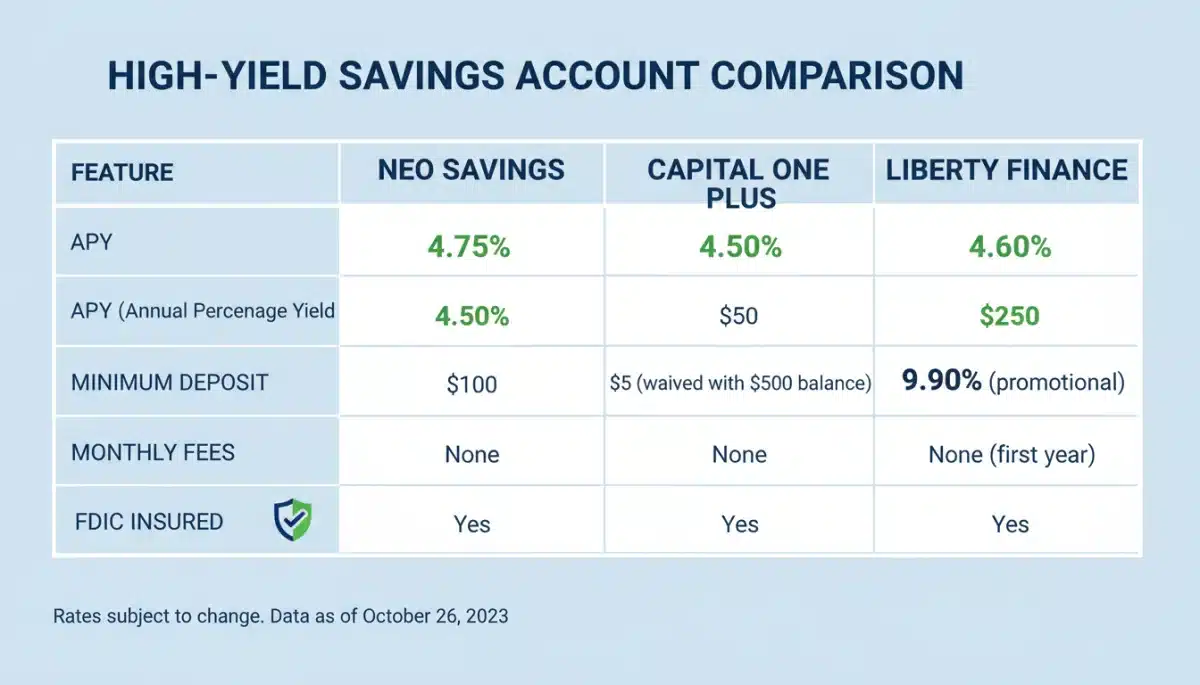
With a clearer understanding of what to look for, the next step is to examine specific high-yield savings accounts that are currently offering APYs above 4.5% in 2026. This comparison will highlight key features, minimum requirements, and any unique benefits or drawbacks associated with each option. Remember that rates can change, so always verify the latest information directly with the financial institution.
This section will provide a snapshot of some of the leading contenders, giving you a practical starting point for your research. The goal is to help you identify accounts that align with your financial situation and preferences, moving beyond theoretical considerations to actionable choices.
Top contenders for 2026 with APY > 4.5%
Several online banks consistently offer highly competitive rates. While specific rates fluctuate, institutions known for their strong high-yield offerings include:
- Bank A: Known for its consistent high APY, no monthly fees, and a low minimum to open. Often features strong mobile banking tools.
- Bank B: Offers a competitive APY with a slightly higher minimum balance requirement to earn the top rate, but provides excellent customer service.
- Bank C: May have tiered APYs, with the highest rates reserved for larger balances, but boasts integrated budgeting tools.
- Bank D: A newer entrant in the high-yield space, offering an aggressive introductory APY with no minimum balance for the first year.
When evaluating these options, consider factors like ease of linking external accounts, customer support availability, and any additional features that might be beneficial, such as automatic savings tools. The best account for you will not just have a high APY but will also integrate seamlessly into your financial ecosystem. Always read the terms and conditions carefully before opening any new account.
| Key Point | Brief Description |
|---|---|
| High APY Focus | Prioritize accounts offering Annual Percentage Yields above 4.5% for optimal cash growth. |
| Fee Awareness | Scrutinize all fees and minimum balance requirements to avoid eroding earnings. |
| FDIC Protection | Ensure all chosen accounts are FDIC-insured up to $250,000 for deposit security. |
| Online vs. Traditional | Weigh the benefits of higher APYs from online banks against the convenience of physical branches. |
Frequently asked questions about high-yield savings
In 2026, an APY above 4.5% is considered excellent for a high-yield savings account. This rate significantly outpaces traditional savings accounts and helps your money grow faster, making it an attractive option for maximizing returns on your cash reserves in the current economic climate.
Yes, high-yield savings accounts offered by FDIC-insured banks are just as safe as traditional savings accounts. Your deposits are protected up to $250,000 per depositor, per insured bank, for each account ownership category. Always verify that the institution is FDIC-insured for peace of mind.
While many high-yield savings accounts, especially those from online banks, boast no monthly maintenance fees, it’s crucial to review the fee schedule. Some may have fees for certain transactions, falling below a minimum balance, or for excessive withdrawals. Always read the fine print to avoid unexpected charges.
High-yield savings account rates are variable and can change frequently, often influenced by the Federal Reserve’s interest rate decisions and overall market conditions. While some banks might adjust rates monthly, others might do so less frequently. It’s wise to monitor your account’s APY periodically.
The interest rate is the percentage paid on your principal balance, typically expressed annually. APY (Annual Percentage Yield) takes into account the effect of compounding interest, meaning it reflects the total amount of interest earned over a year, including interest earned on previously accrued interest. APY provides a more accurate picture of your actual earnings.
Conclusion
The journey to finding the best high-yield savings accounts in 2026, especially those offering an APY above 4.5%, requires diligent research and a clear understanding of your financial priorities. Beyond chasing the highest rate, it involves scrutinizing fees, verifying FDIC insurance, and considering whether an online or traditional banking model best suits your lifestyle. By adopting a strategic approach and regularly reviewing your options, you can ensure your cash is working optimally for you, transforming your savings goals into tangible financial growth. Making an informed decision today will set a strong foundation for your financial well-being tomorrow.