Privacy in Public Spaces 2026: Laws and Your Rights
Anúncios
In 2026, your right to privacy in public spaces is governed by a complex interplay of federal and state laws, balancing public safety with individual liberties amidst evolving surveillance technologies.
Anúncios
Understanding public space privacy laws in 2026 is more crucial than ever as technology rapidly redefines what it means to be truly private.
From advanced facial recognition to pervasive CCTV networks, the line between public safety and individual liberty is constantly shifting.
Anúncios
The evolving landscape of public surveillance
The presence of surveillance in public spaces has expanded dramatically, driven by technological advancements and perceived security needs.
What was once limited to static cameras has evolved into sophisticated systems capable of real-time tracking and data analysis.
Technological advancements in surveillance
Modern surveillance systems go far beyond simple video recording. They now incorporate artificial intelligence, machine learning, and biometric identification.
These technologies allow for unprecedented levels of monitoring and data collection, raising significant questions about the scope of individual privacy.
- Facial Recognition: Identifies individuals in crowds, often without their explicit consent.
- AI-Powered Analytics: Detects suspicious behavior patterns or aggregates demographic data.
- Drone Surveillance: Offers aerial views for monitoring large areas, enhancing real-time response capabilities.
- License Plate Readers: Tracks vehicle movements across cities, often stored in vast databases.
The implications of these tools are profound, impacting everything from law enforcement tactics to urban planning. While proponents argue for increased efficiency and safety, critics point to the potential for abuse and the erosion of fundamental rights.
Navigating this complex landscape requires a clear understanding of current legislation and ongoing legal challenges.
Federal protections and limitations for privacy
At the federal level, several laws indirectly touch upon privacy in public spaces, though none specifically grant an absolute right to privacy in such environments.
The Fourth Amendment, protecting against unreasonable searches and seizures, is often cited, but its application to public surveillance remains a subject of intense debate and judicial interpretation.
The Fourth Amendment and public expectations
The core principle of the Fourth Amendment hinges on a “reasonable expectation of privacy.” Generally, courts have held that individuals do not have a reasonable expectation of privacy in public places where their actions are visible to others.
However, the introduction of advanced surveillance technologies challenges this traditional interpretation, prompting calls for updated legal frameworks.
For instance, while a person cannot expect privacy from a police officer observing them in a park, the question arises whether they can expect privacy from an AI system that tracks their every movement and analyzes their behavior over extended periods.
This distinction is crucial for understanding the future of privacy rights.
Furthermore, federal laws like the Electronic Communications Privacy Act (ECPA) primarily address electronic communications and stored data, not general public surveillance.
This leaves a significant gap in explicit federal protections for individuals in physically public settings, especially concerning video and sensor data.
State laws: A patchwork of regulations
Given the limited federal scope, state laws play a critical role in defining the boundaries of surveillance and privacy in public spaces.
However, this results in a highly fragmented legal landscape, where protections can vary significantly from one state to another.
Differing approaches to surveillance technology
Some states have proactively enacted legislation to regulate specific surveillance technologies, such as facial recognition.
Others rely on existing tort laws, such as invasion of privacy, which can be difficult to prove in a public context.
- Biometric Data Laws: States like Illinois have strict laws regarding the collection and use of biometric data, including facial scans.
- Public Records Acts: These laws can sometimes be used to access information about government surveillance programs, promoting transparency.
- Consent Requirements: A few states require explicit consent for certain types of data collection, even in public settings, particularly if personal identifiers are involved.
The lack of uniformity creates challenges for both individuals and law enforcement agencies.
What might be permissible in one state could be illegal in another, leading to confusion and inconsistent application of privacy principles.
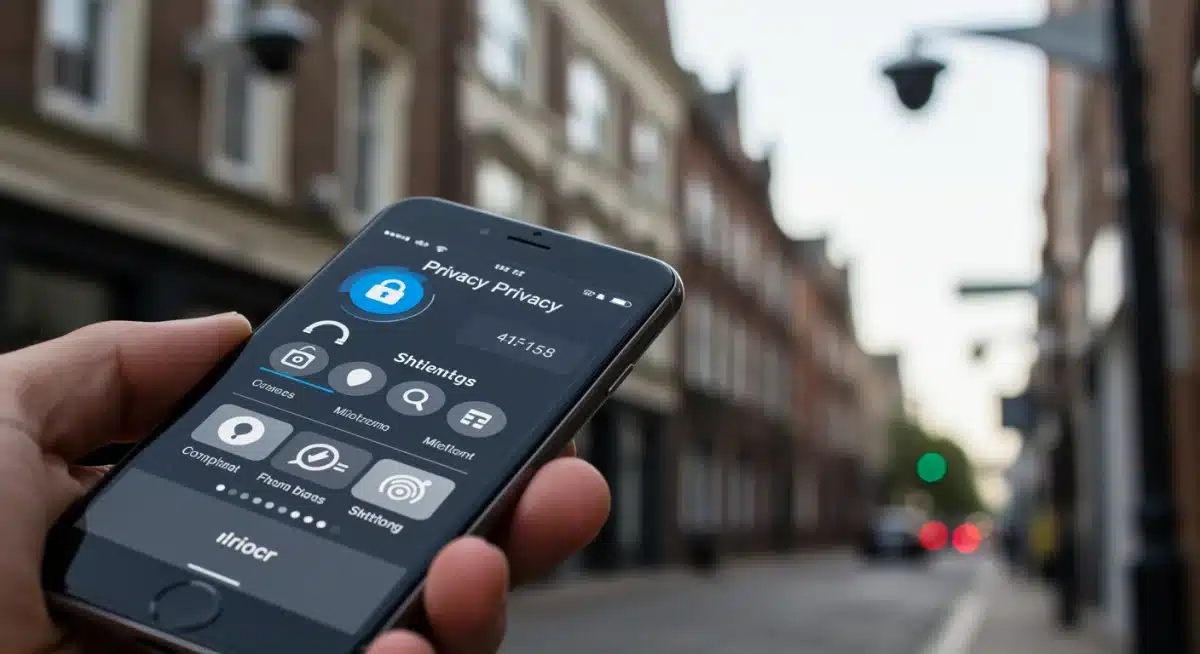
What surveillance laws permit and prohibit in 2026
In 2026, generally, law enforcement is permitted to conduct surveillance in public spaces without a warrant, provided there is no reasonable expectation of privacy.
This includes the use of CCTV cameras, plainclothes officers, and even some drone operations.
Permitted surveillance activities
Activities that are typically permitted often fall under the umbrella of maintaining public order or investigating crimes.
The key is that the surveillance must be conducted in a manner that does not intrude upon areas where an individual would reasonably expect privacy, such as inside their home or a private vehicle.
- General Observation: Police can observe individuals in public parks, streets, and squares.
- CCTV Networks: The installation and use of cameras in public areas by government entities are generally allowed.
- Undercover Operations: Law enforcement can conduct covert surveillance activities that are not deemed an “unreasonable search.”
Prohibited surveillance activities
Prohibitions usually arise when surveillance crosses into areas of reasonable privacy or when specific technologies are used without proper legal authorization.
For instance, using thermal imaging to peer into a home typically requires a warrant.
Moreover, the collection and use of biometric data are increasingly regulated, with some jurisdictions requiring warrants or strict consent for its application.
The debate often centers on whether a technology creates a “search” where one did not exist before, triggering Fourth Amendment protections.
The impact of emerging technologies on privacy rights
The rapid advancement of technologies like AI-powered analytics, predictive policing, and ubiquitous sensor networks continues to challenge existing legal frameworks.
These tools often collect vast amounts of data, not just about individuals, but about entire populations, raising concerns about mass surveillance.
AI and predictive policing
Predictive policing algorithms analyze historical crime data to forecast where and when crimes are likely to occur.
While proponents argue it improves resource allocation, critics worry about inherent biases in the data leading to discriminatory targeting of certain communities.
Similarly, AI-driven analytics can quickly process hours of video footage, cross-referencing it with other databases to identify individuals, track their movements, and even infer their intentions.
This level of pervasive tracking fundamentally alters the nature of public interaction and raises questions about the freedom to assemble or express dissent without being monitored.
The legal system struggles to keep pace with these innovations, often relying on outdated precedents.
There is a growing call for new legislation specifically designed to address the unique privacy challenges posed by these powerful technologies.
Advocacy and future outlook for privacy
Privacy advocacy groups are at the forefront of pushing for stronger protections and greater transparency regarding public surveillance.
They argue that the current legal framework is insufficient to protect individual liberties in an increasingly monitored world.
Key areas of advocacy
Advocates focus on several critical areas to strengthen privacy rights.
This includes advocating for clear legislative action, challenging overreaching surveillance programs in court, and educating the public about their rights.
- Legislative Reform: Pushing for federal and state laws that explicitly regulate advanced surveillance technologies.
- Transparency: Demanding that government agencies disclose their surveillance capabilities and data retention policies.
- Accountability: Holding agencies accountable for misuse of surveillance data or technologies.
- Public Education: Informing citizens about their privacy rights and how to protect themselves in a monitored environment.
The future of privacy in public spaces will likely depend on a continuous dialogue between technological innovators, policymakers, legal experts, and the public.
Striking the right balance between security and liberty will remain a central challenge for years to come.
| Key Point | Brief Description |
|---|---|
| Evolving Surveillance | Public monitoring now uses AI, facial recognition, and drones, challenging traditional privacy notions. |
| Federal Limitations | The Fourth Amendment offers limited protection in public; no specific federal law for general public surveillance. |
| State Law Disparity | State laws vary widely, creating a fragmented regulatory landscape for public surveillance technologies. |
| Future of Privacy | Advocacy groups push for stronger legislation and transparency to protect privacy against new tech. |
Frequently asked questions about public privacy
Generally, yes. In public spaces where you have no reasonable expectation of privacy, you can be filmed without your consent. This applies to both private citizens and law enforcement, provided the filming doesn’t intrude into private areas or harass you.
Protection varies by state. Some states, like Illinois, have stricter biometric privacy laws requiring consent for data collection. However, federal law offers limited explicit protection against facial recognition in public, making it a state-by-state issue.
This legal concept determines if the Fourth Amendment applies. In 2026, it generally means you don’t expect privacy in areas visible to the public. However, new technologies like persistent tracking or highly intrusive sensors are challenging this traditional interpretation.
The legality of drone surveillance by law enforcement is still evolving. While some uses are permitted for public safety, debates continue regarding their use for general surveillance without warrants, especially concerning data collection and retention policies.
While complete privacy is difficult, you can be mindful of your digital footprint, use privacy-enhancing apps, and advocate for stronger privacy laws. Being aware of local surveillance policies and supporting privacy organizations also helps protect your rights.
Conclusion
The landscape of privacy in public spaces in 2026 is complex and constantly evolving, shaped by rapid technological advancements and a fragmented legal framework.
While federal laws offer limited explicit protection, state regulations and judicial interpretations are striving to catch up with the capabilities of modern surveillance.
Understanding your rights and the limitations of current laws is crucial for navigating an increasingly monitored world.
Ultimately, the balance between public safety and individual liberty will continue to be a central topic of debate and a driving force behind future legal reforms.